VA/CA - Meditation and Emptiness
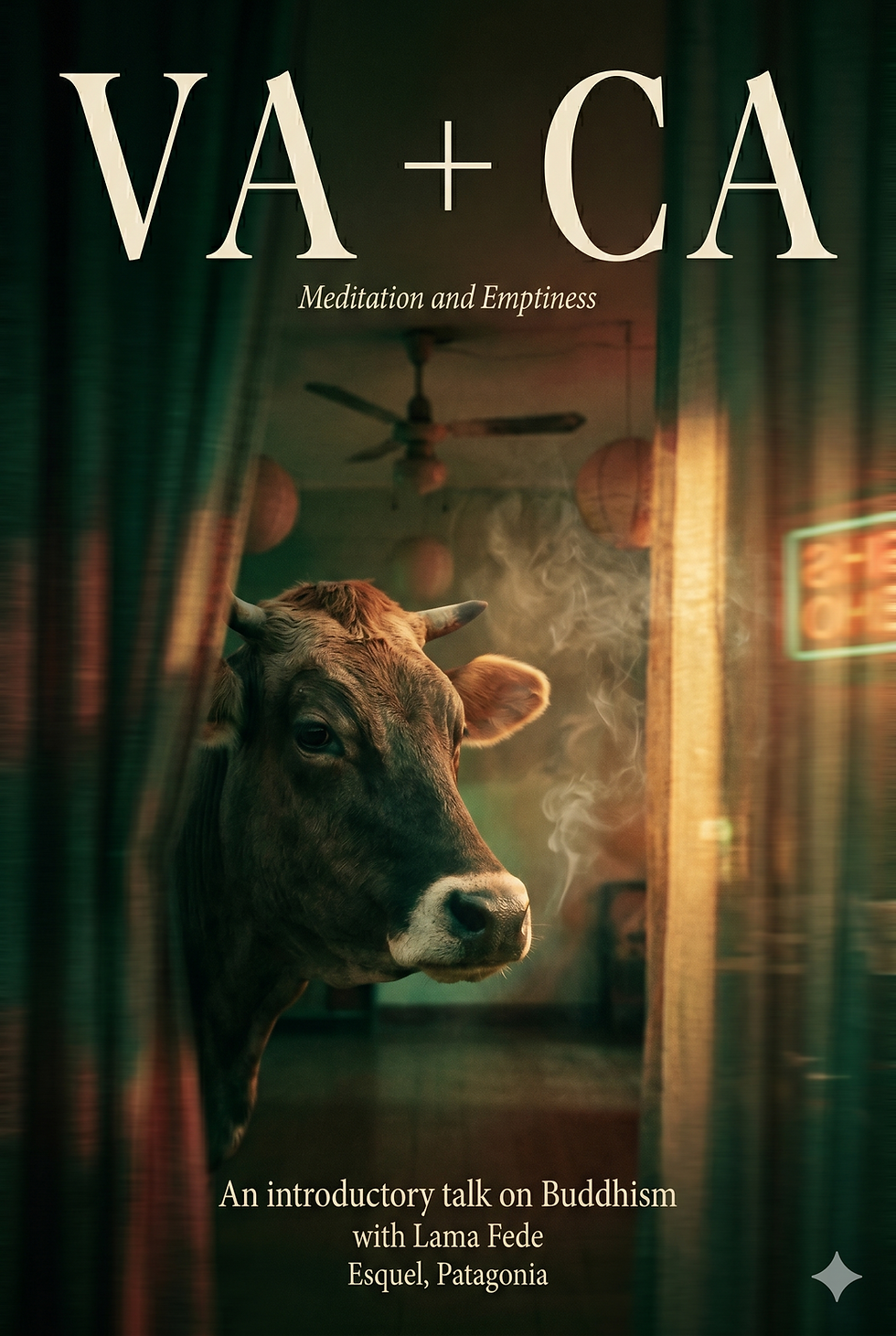
VA + CA: Meditation and Emptiness
An introductory talk on Buddhism, given in Esquel, Argentina.
What does what we’re going to do tonight have to do with the teaching of the Buddha Shakyamuni? The Buddha was a person who lived in what is today India and Nepal, 2,500 years ago. There’s a great deal of confusion and many conceptions about what Buddhism is, but probably the simplest way to put it is that it’s the teaching of a person who found a way to exist beyond suffering.
And those teachings, unlike many Western traditions — Greek, Roman — that suffered interruptions, have been developing without a break for 2,500 years. Imagine: we humans can’t spend ten minutes without making something new. So there are thousands of schools. Ours is one. Not the best, and — I hope — not the worst. I trust we’re not the worst.
Essentially, this is what we devote ourselves to. And our goal, like the goal of most Buddhist schools, is to transmit this experience, this teaching of the Buddha, so that all of us here can — if not free ourselves entirely from suffering — at least make some progress on the path, and know that the possibility exists. After that, each person decides what they want to do.
When people first start hearing the teachings, they often don’t like them, they find them strange. It’s true: they are strange. And it’s good that they seem strange, because what Buddhism is telling us is that everything we’ve been doing in our lives has brought us to this place. To change something, we need to do strange things. But they’re not going to be the strange things you probably imagine. You won’t need to put on a robe, you won’t need to shave your head — as you can see, this is barely any hair, it’s not that I’ve shaved, it’s the little bit I have left. The changes have to do with much more fundamental things: that there is no self, that there is no creator God (though there are thousands of deities), that there is no intrinsic meaning to life. Things we cling to. And Buddhism is going to teach us, basically, that this clinging is what makes us suffer.
I’ll ask you one favor: I speak fast and I speak in a clipped way — I sound very porteño. I’m trying to get past it, I know it’s a flaw of mine. Stop me whenever you want, interrupt me, ask me anything. If you get angry, tell me. Please don’t leave angry. I’d rather you tell me, because — believe it or not — it actually makes me happy when people get angry: it means they listened. The worst thing that can happen to me — and it has happened — is to have students I’ve been teaching for years who are stuck in exactly the same place. If they haven’t moved at all, I feel like what I said had no meaning. If you get angry, at least you listened to me and understood me. And that’s already something.
The Refuge
To begin, a traditional thing is to chant the refuge. It’s like the opening of a Buddhist session. If you want, follow along; if not, that’s fine too. This isn’t a conversion to Buddhism — there’s no conversion in Buddhism in that sense — it’s simply a way of establishing a space for the teaching.
It’s done three times:
Namo Buddhāya, Namo Dharmāya, Namo Saṅghāya.
Hail to the Buddha, the Dharma — his teaching — and the Sangha, those of us on the path. A way of showing respect. And then, once:
Oṃ Bodhicittam Utpādayāmi.
May bodhichitta — the spirit of awakening, the key to the path — arise in me and in all of us.
Who likes cows?
Thank you all for coming tonight. Forgive any problems with the transmission — those are mine. My teachers have been buddhas, but my transmission isn’t up to the task. I’ll do my best.
Who likes cows? I do. I go out to the countryside, I see cows, and it makes me happy. They’re nice, they don’t attack me — which is a point in favor of any animal. Does anyone here not like cows? Anyone with a phobia? Because today I’m going to talk a lot about cows. Why? Because we’re going to talk a bit about meditation and emptiness.
I want us to talk about cows today so we remember the two components Buddhism attributes to the nature of mind. Anyone who’s been here before remember? There are two: emptiness and clarity. In Spanish, vacuidad and claridad. VA + CA. Vaca — cow in Spanish. That’s the mnemonic for tonight.
Let’s try to remember it: for Buddhism, emptiness and clarity are the ultimate nature. It means that everything we perceive, everything we see, is emptiness and clarity. It’s hard at first because people have expectations. If I tell you, “I’m going to share the ultimate secret of Buddhism,” you’re expecting a spell, a formula for winning the lottery, immortality. And what I tell you is: emptiness and clarity. Vaca. It’s the hardest thing to explain and the last thing anyone expects.
When Buddhists talk about emptiness and clarity, we mean something very specific.
Emptiness means that what we call things, people, objects, situations, are nothing more than moments in changing processes. You can see this in yourselves. You were born and you have the same name, but of what you were as children, nothing remains: not a single cell. The shape of the body changed — mine has generally grown sideways. I, believe it or not, used to have black hair.
None of it’s left. We keep changing, and yet we assume some kind of continuity, we assume that continuity is based on something. But when you investigate, there is no “something,” there’s no soul, there’s no little spirit. There’s a continuity, like in a roll of film: the frames pass so fast that they give the impression of something. But it’s an illusion.
This doesn’t only happen to us, it happens to everything. Behind you there’s a painting. At some point that was vegetable pigments. At some point it’s going to grow old, get thrown out, get burned, become ash, become part of the ground. Nowhere in that painting is there something called “painting”: it’s the way we name a clump of matter by the function it serves.
There’s a famous text, the Milindapañha, in which the sage Nāgasena converses with the Greek king Menander. Nāgasena says: explain to me which part of the chariot is the chariot. If I take a wheel off, is it a chariot? Yes, it’s a chariot missing a wheel. What part do I take away to make it stop being a chariot? And the truth is, there is no “chariot thing.” There’s a set of parts that we put together and call a chariot.
That’s what Buddhism calls emptiness. Something is empty not because it doesn’t exist, but because it doesn’t exist in an essential or unequivocal way. This isn’t a cup because somewhere there’s a perfect, Platonic idea of a cup. This is a cup because we call it a cup. In ten thousand years, possibly, “cup” won’t exist, or we’ll call it something else. That there’s no unequivocal something, but rather things that arise and depend — that is emptiness.
Clarity, on the other hand, is the story we tell about phenomena. When I start thinking — I see Luis, I remember when we used to drive along the highway looking at condors, or the times we went to the natural sciences museum — all of that is clarity. It’s a slightly odd term. It has to do with the fact that there are things I can distinguish. As if I were in a dark cave with a light: I see reflections. Those reflections, the story I tell about things, are what I call clarity.
The point and the lotus: an experiment
Emptiness and clarity are very abstract terms. If you come to a meditation talk and they’re talking to you like this, you want to die: I’m talking about identity and Platonic things. So I’m proposing we spend forty minutes seeing whether we can understand today, experientially, what emptiness is and what clarity is. From here on I’ll talk very little. When you have questions, tell me.
First: sit in whatever way is most comfortable for you. There’s no “meditation posture” — that’s also a truth. There are different positions to make you comfortable. Lean back, sit in lotus, in half lotus, whatever doesn’t hurt. Stretch your legs, tuck them in, it doesn’t matter. The important thing is that you’re going to be looking at the floor for a while.
Choose a point. It’ll be your point throughout the session. When I say “we look at the point,” you look at the point. It can be a wall, the ceiling, the floor. I suggest something within your visual field looking forward. Important: don’t pick another person, because the other person will move and make faces, and we’ll get distracted. It can be looking at infinity, but choose a point.
Now, look at it for a few seconds. What’s going to happen, if you’re anything like me, is that within half a second you’ll start thinking things. “What am I doing here?” “I’m boring him.” “My legs hurt.” It doesn’t matter. When you find yourself thinking about something, look back at the point.
[Pause to look at the point.]
Now, without taking your gaze off the point, imagine a blue lotus. If you don’t know what a blue lotus looks like, imagine a blue flower. Imagine the petals. Imagine the smell, like perfume. Imagine it opening and turning in every direction.
[Pause.]
Now, with the flower clearly visualized, let me ask you something: where is the point? Let the flower go and come back to the point.
Did you register the change? Did you feel the difference between how the flower feels and how the point feels? What happened to the point while you were imagining the flower? It vanished, it went out of focus, didn’t it?
Let’s remember the vaca. The VA — emptiness — is like space.
(Some other day, if you want, I’ll tell you how this teaching arose. It has to do with the sage Nāgārjuna, with a phrase: space has no capacity to listen to you. You know how people say, “I’m going to send it out to the universe,” “I’m going to manifest it to the universe”? The universe doesn’t perceive. Space has nothing in it. Let’s call space, at least for this talk, emptiness. It’s not exactly emptiness, but it’s close.)
The flower, on the other hand, is clarity. It’s the way I take a story — in this case the one I proposed to you — and it starts to occupy my attention.
My thesis for tonight: we are not VA, and we are not CA. We are VACA. The non-dual Buddhist union of the two. This conscious dream, this lucid dream we want to attain — which is enlightenment — has to do with knowing we’re in a dream and, at the same time, that the dream is empty: it can be modified.
We’re going to do five more experiences. In this first one, what I want you to feel is the sensation — because it is a physical sensation — of the difference between the VA mode (observing) and the CA mode (producing, telling a story).
This is important because a lot of our confusions come from assigning things from CA to the VA mode, or the reverse. We go to a place and say “bad vibes here.” That’s fine if we understand it’s our reaction to the causes and to the place. It’s not fine if we think it’s an intrinsic quality of the place or the person — “this person gave me bad energy.” Maybe the person had a bad day. Maybe the person really is a disaster. The difference between “this person is a disaster” and “I didn’t click with them, so I think they’re a disaster” depends on whether I let my CA bleed into the VA, or vice versa. And other times we do the opposite: we let the VA, the space, be the only thing that matters — the action, the external — and we don’t pay attention to the CA, the intuitive.
So the idea is to understand that there are two modes and that we need both.
Is emptiness the same as empty?
Question: — What would empty mean?
Good question. The point you imagine is an empty point in your mind — you’re imagining the point. How can you imagine an empty point? If I tell you, “don’t think about anything,” can you not think about anything? That’s why you’re not imagining something empty: you’re thinking about a point.
A complex thing about the mind is that you can’t represent a negative. Let’s think of an example — I’m not saying it’s actually like this, just take it as an example.
Suppose we’re entirely material; let’s do the most materialist speech in the world: we die and there’s nothing. Can we think of a death like that? No. We can imagine a darkness, but we can’t think about not thinking. “Thinking about not thinking” is also a representation of something. We can only access certain things by imagining them. We cannot imagine the non-existence of an object.
So if you say, “there’s a point where there’s nothing,” you couldn’t perceive it.
There could be a point with nothing in it, but you couldn’t think it. At most, you could infer its existence by absence. We see smoke and we think: someone is burning the woods. We infer. But we can’t even know that there’s an empty point.
If there were an empty point you couldn’t think, you couldn’t even say so.
The big problem is that empty and emptiness are translations of the Sanskrit word śūnyatā. And śūnyatā means non-essence, roughly. When we talk about emptiness it doesn’t mean there’s a point that’s empty. This table, even though it doesn’t look it, is empty: it has no “tableness” essence, it’s a piece of wood that was put together this way. I am empty. And empty doesn’t mean blank.
That’s why often, when people start meditating — when I started I bought into the line, the same line a lot of people buy — you think meditating is thinking about nothing. Putting your mind blank. You can achieve that with a quarter of a bottle of whisky. With a quarter bottle of whisky I get my mind as blank as it can possibly go. That’s not meditating.
Meditating, at least in the context of this talk, and enlightenment — being a Buddha — I’ll go further: it’s having a lucid dream with yourself. Do you know what a lucid dream is? A dream in which you’re aware that you’re dreaming. We do a dream yoga to develop that capacity. Has anyone here ever had a lucid dream?
A dream in which you knew you were dreaming?
— I have.
And what’s it like? Dreams are real in the moment you’re living them: you live them as real. But when you live them knowing they’re a dream, the dream changes. You can change it at will. If you’re aware, you have the possibility of changing it. How did it feel? Was it like other dreams, or did it feel different? Do things feel just as intense, or much more so?
It’s nice. That’s clarity. Let’s imagine the final goal is for our entire existence to be like that. Let’s take it as a hypothesis. I’m not saying it is so, we’re going to keep testing it.
Pleasure and fear
Now we’re going to do something different. We’ll go back to looking at the point. Then I’m going to ask you to imagine a canvas and paint on it something that gives you pleasure.
You don’t have to tell anyone what it is. And it doesn’t have to be something spiritual or pretty. If you take pleasure in something terrible — I don’t know, there are people who enjoy firing employees, I’ve unfortunately heard about this, apparently they’re horrible influencers; in my company, when I saw people firing others, I wanted to kill whoever was doing it, but there are people who love it — I’m not judging. I’m just giving an example. Choose whatever you want, even if it seems shameful. You don’t have to tell anyone. But visualize it. Imagine it. Paint it in maximum detail.
If it’s something you really like, you’re going to start feeling a little relaxation, a smile. Intensify it. Make it bigger and bigger, until you’re inside the situation.
We start as always, looking at the point. A little VA. And now we start painting the situation. We make it bigger and bigger. We focus on how it feels, how it sounds, how it smells, how it feels on the skin.
And now we go back to the point. We dissolve everything in the point and come back.
Did you feel a bit of happiness? The shadow of it, the memory of it? Where did it come from? Where is it? Because clearly it wasn’t in the space. Notice that you can generate pleasure with a story.
Now, the opposite. I want you to choose something that frightens you. Something terrible. It can be something that happened to you, it can be an object, a person, a betrayal. Don’t worry: this is the only unpleasant thing we’re going to do. I want you to feel that sensation, and then we’ll dissolve it in the point.
A little VA. The point. And now we imagine that terrible thing. We make it big. We get into the situation. We feel that abyss opening in the chest, in the floor.
We come back to the point. We dissolve everything. We come back here.
Did you feel the difference? Did you feel the change of energy? And what changed in the space? Absolutely nothing. The space is there. Totally neutral.
What changes is the story we tell ourselves.
When we don’t notice the shift between these two modes, between VA and CA, that’s when we start to have problems in life. I’m not saying VA is the way to be, or that you have to be always “in the present moment with no thoughts.” No. We move. And in fact they’re not two things: there’s no outside and inside. The perception we have out here is also our mind. But the mode focused this way and the mode focused that way are different.
Dreams that intersect: samsara and karma
Imagine you have a beautiful dream, doesn’t matter what. You wake up happy, rested. You go out and you run into someone from work you don’t especially get along with. Since you’re happy, you ask how they are, you chat, you find the best in that person in that moment. That impression of yours, repeated over several days, gets reinforced. And you’ll end up developing a relationship based on that impression.
Imagine the opposite. You have a distressing dream. You wake up tense, tired. You run into the same person, but they catch you in a bad moment. You answer them curtly. The perception is: “this person has bad energy, they’re horrible.” They start treating you worse and worse. You’re trapped in the same situation, repeated.
The stories we tell ourselves — and the stories others tell about us — are extremely important. They’re what binds us or what frees us. It’s what Buddhism calls samsara: the everyday world, the world we dream.
A great Buddhist intuition is that the world is a dream. That sounds horrible if you’re saying, “I want this to be all real.” But it has a great upside: a dream can be changed. And dreams aren’t necessarily ours. We don’t live in a bubble where the only thing that matters is what happens to us. There are countless other dreams, of people in other parts of the world, that also affect us.
For example, today we were talking about the hill next to the airport, with Lama Cele. Some people dream about the mountain as a place to walk, to explore. And some people dream about the gold inside the mountain. Two dreams in conflict. From those two dreams an experience will arise. What’s interesting for Buddhism is that it’s not that one dream is better and another is worse: each dream produces a result.
That’s karma. Karma isn’t a deity that tells you, “your turn today.” It’s not some crazy aunt watching from somewhere who marks you. No, no, no. (For some parts of Hinduism, yes; for Buddhism, no.) Karma is the kind of action we do and how we then frame it.
If we get used to learning, for instance, that killing people is okay in service of our country, our king, whatever, it becomes more likely that in a heated argument we’ll end up killing someone. Because we’ve already done the exercise.
One of the great problems for armies all over the world — not just Argentina’s — is training people to kill selectively. From ancient times. Julius Caesar wrote about this a lot in his Gallic Wars: the most violent people couldn’t be good centurions, couldn’t be good soldiers, because the question wasn’t to kill, it was to kill discriminately. And that’s much harder. That’s karma.
And let’s think about something good. If we get used to creating spaces of love, support, kindness, it will be easier for the people around us to feel it and respond that way. In that interaction, in those dreams that come together, the world arises.
We have advantages and disadvantages. The advantage is that, for Buddhism, the world is less solid than we’re used to thinking. Since this isn’t necessarily this way, it could be otherwise. Today, I prefer having some agency and some power — even if just over myself, a minimal power — I prefer deciding what I like and understanding that the world can be thought differently, rather than thinking the world is the way it is and there’s nothing to be done. On the other hand, remember: it’s not your will alone that decides the world. You are nothing more than the intersection of countless dreams.
The path you can take, and the path you can’t even think
We’re going to do two more meditations. The third: visualize the point. Then imagine something you would really like to be possible. Imagine yourselves here, now, and imagine that desirable situation. Going from that desirable situation, walk the path back to where you’re sitting now. In reverse: step by step, from the goal to you.
It’s a simple but interesting exercise. And I want you to take with you the sense that it’s a path that can be walked. That’s what matters: it can be walked. You’ll see in the next meditation why.
A little VA. Visualize the point. Visualize the possible goal. How it feels. We go backwards, step by step, until we’re back here now. And now we walk each of those steps forward, until we reach the goal. We feel that we made it.
We come back to the point. We dissolve everything. We come back.
Could you do it? Did you feel yourself doing the things to reach the goal? Did you like it?
Now we’re going to do something slightly different. Imagine that we’re all in Bodhgaya — the place we’re going next year; I’ll tell you about it later. Don’t imagine we’re doing a tour: the non-touristy part of Bodhgaya is worse than any shantytown around here. Imagine yourselves dressed in rags, sweating from the heat — Bodhgaya gets very hot, especially this time of year — really tired, with dust down to your throats, two hundred beggars asking you for change. Worse: we are the beggars.
Now imagine, from where you are now, all the intermediate steps to get there: leaving your home, leaving your money, leaving everything, simply to go eat the dust of a Buddhist city. Something completely unknown and unappealing. It’s an experiment. I’m sure no one wants to do it. Later you’ll all want to.
But not now.
If you don’t want it to be Bodhgaya, pick any other city. But Bodhgaya is symbolically different.
A little VA. The point. Now visualize: the ugliest city you can imagine, you as ragged beggars, hungry, thirsty, dust in your throats. And now let’s walk the path backwards: leaving your home, your clothes, your friendships, to go beg on the other side of the world. Imagine your family’s reaction, your friends’ reaction. Imagine carrying out the whole plan and ending up as thirsty beggars in an Indian city. We come back to the point. We let it dissolve. We stay briefly with the sensation. And we come back.
How was it? Pleasant? No. Did anyone find it easy?
— It was hard for me. I didn't want it to actually feel it as real.
That dissociation. That’s what matters. We struggle, we go and come back, we find excuses. That movie we make for ourselves — in which I never said “think about stopping halfway, going and coming back.” I said: we go and we sit there. All those distortions have to do with the fact that our mind hates — hates — the things it has aversion to.
In Buddhism — and talking about Buddhism in Buddhist terms is very strange for us, the terms are very technical — we all have desire and aversion. We all have things we want and things we don’t want. The problem, Buddhism says, is the way we relate to that.
Notice something. We’re in a meditation space, in a meditation workshop, experimenting with the mind. And yet, when I told you, “give me all your money, let’s go somewhere else,” just thinking about it was hard for us. So hard that we had to go back and forth, dissociate, build stories just to be able to think the situation. Or say, “I’m not going to die, I’m going for a visit.” It’s hard for us even to think the things we feel aversion towards.
This is key. We have that neoliberal fantasy — have you heard it? — that with one’s desire alone, the mind can do anything. You define your universe. You manifest your reality. If that were true, we all define our universe — tell me: who manifested Argentina’s economic situation? Bring them over and we’ll beat them up.
What builds our world is desire. And it builds it to the point that we don’t know we’re choosing. The only real choice we make is the one we don’t know we’re making. We think we’re choosing the toothpaste. But nobody cares about toothpaste.
No one I know is dying for Colgate or whatever. Choices feel like they aren’t choices, they feel like natural things. You know how someone says, “I heard her speak and I just knew she was the one”? That’s a choice. It’s just that our mind hides it from us and distorts it so that we don’t notice.
That’s why what happened to you on that horrible trip — the distortion, the dissociating, the going-back-and-forth — is the mind’s defense mechanism saying, I don’t want this, so I’m not even going to choose it. And in that we lose freedom. Because we can’t think a different life. And it’s not that the different life is unthinkable. Is it thinkable that we leave everything and go beg in a city in
India? Yes, it’s thinkable. I don’t want to do it.
But if I can’t even imagine it, I’m already conditioned.
What I want you to take away
Of the two modes, VA and CA, CA is generally going to be the more important one, because it’s the story we’re constantly creating. And it will condition your choices. And it will condition how you see the VA.
That’s why in Buddhist practice we start by focusing on the VA. What do we do? Shamatha, for example. Looking at space. Looking at your breath, feeling your breath. And it will be boring. Because space, being so neutral, is interesting in this way: it’s always there. Knowing it’s always there has a great advantage: when you feel that the CA mode is eating up the VA, remember that the space hasn’t changed. If you wake up in your room anxious, and the next day you wake up happy, and the third day anxious again, the room hasn’t changed. What changes is the story.
And stories can be changed. Knowing that — knowing that what is happening to you can be changed — doesn’t mean you can change it right away. I’m not saying that with two minutes of meditation your life gets fixed. Therapy is important.
Looking for help is important. Knowing that meditation takes years and years of development is important. But knowing that what is happening to you isn’t the world, that already opens up some space to move.
I do Jiu-Jitsu. I love it. I practice several styles. I love going to compete; I’m fighting at the Pan-American next when I’m back in Buenos Aires. Jiu-Jitsu, on the ground, is: a fat guy like me comes in, and an even fatter guy comes in, they take you down and lie on top of you. Do you know what you have to learn there? To make small spaces for yourself so you can move. If we have a lot of space, we’re fine, we escape. But a lot of life is like this: life falls on us and we look for cracks to breathe through. What meditation is going to give us is exactly that: remembering the cracks exist. That space doesn’t change.
— You’re always going to look for a meaning.
Yes, that’s what the mind does. And — careful — at no point did I say “to die.” It’s recorded, it’s transcribed. I said, “to do this experiment, only for this experiment.” I didn’t say “the meaning of life”; in fact, at the beginning I said the opposite: that life has no intrinsic meaning. That search for meaning — “well, if I die there at least I’ve gotten somewhere better” — is a story the mind builds to give meaning to the situation. That’s what we have to learn to see. The mind will never stop building. The mind never stops thinking. The mind only stops thinking when somebody dies.
Questions
— Isn’t the function of something exactly what makes it that thing? The car is a car with or without the key, as long as it works as a car.
Right. Function. But function is something that comes and goes: today it’s like this, tomorrow it isn’t; today I’m here and my function gives meaning to my presence, but I won’t be here forever.
— I was thinking about will. How much of what we do is up to us through will? Being kind, showing up — is that a voluntary force? Or is it innate?
I don’t know if you can always change it through will. Will, in Sanskrit cetanā, isn’t the most important thing. The most important thing is desire. Desire is what structures things. Will only chooses among the things that come your way.
And many times the problem lies in what we don’t see: that we have an option.
The choice we believe to be free is completely conditioned. Anthropology and sociology help a lot with this. Most people who fall in love, fall in love within their own social class. You’d say: why? If the choice of love is free. But it’s very rare for someone from the upper class to date someone whose life is very different. That happens in novels. And they work as novels precisely because they’re an escapist desire — because it doesn’t happen in reality. And it doesn’t happen because the choice we assume is free is super-conditioned by our class reality. The heir to the financial empire knows intrinsically that he can’t fall in love with someone from a slum: his family will disinherit him. It’s not even thinkable. And that not-being-thinkable is exactly what happened to you in the meditation. We are already conditioned. The choice we assume to be free is, in reality, super-conditioned.
What Buddhism says isn’t “choose something else.” What it says is: notice. Be aware.
The takeaway for tonight
And this is the message of tonight’s talk that I want you to take with you.
Essentially, for Buddhism, we are dreaming all the time. And the dream mechanism — something the Buddha said two thousand-some years before Freud — is the same mechanism we have when we’re awake. You think you’re awake, but you’re actually dreaming. That’s why the root bud-, in Buddha, means the awakening. The Buddha is the one who understands this.
But getting enlightened doesn’t mean you travel to another world or stop talking. The Buddha made jokes. Terrible jokes. He had a very acid sense of humor. He’d get angry.
In one of my favorite sutras, the Buddha gets fed up with the monks and says, “I can’t stand them anymore, why did I bother teaching? I’m off to the woods, goodbye,” and disappears for three years. He comes back, sees the community, and says, “no, that’s it,” and goes off again for another year. “I don’t even want to come back.” This was the Buddha.
What I mean is, you don’t disappear or turn into something else. What changes is that you realize it’s a dream.
The Buddhist capacity — and your capacity — to see the vaca is the capacity to notice when CA is bleeding too much into VA, or when VA is bleeding too much into CA. When you notice that this is happening all the time. Because you never go off so far that you lose all perception: you can be visualizing whatever you like, but if I start dancing in the middle of the room you’ll look at me. There’s a minimum perception. And you’ll never be so locked onto the point that no thought arises. Not, at least, without a lot of meditation.
When you start to catch the sensation — because it is a physical sensation, like riding a bicycle, it’s not something intellectual that you suddenly figure out — of how attention shifts between the two modes, you start to feel the balance. On a bike you don’t think “I’m at 35 degrees, I have to compensate.” You move it with your body.
When you understand that, VA and CA stop being two separate things, and what remains is the vaca.
— Is it a lot like Judaism, like Kabbalah? In Kabbalah you also see this, that you are the one who can choose either way.
I’d say in Kabbalah, especially, it’s pretty much the opposite. Because there’s an Ein Sof. And the Ein Sof is, in fact, exactly the criterion that most binds you to the idea that there is a direction, so to speak.
VA + CA: Meditation and Emptiness — Key Points
In one sentence: Buddhism teaches that the ultimate nature of mind has two components — emptiness (VA) and clarity (CA), together vaca (Spanish for cow) — and the practice consists in noticing how they interact, instead of confusing one for the other and getting trapped in stories we mistake for reality.
What it’s about
An introductory talk on Buddhism given in Esquel, Argentina, addressed to a general audience not necessarily made up of practitioners. Lama Federico presents the fundamentals — emptiness, clarity, samsara, karma, desire and aversion — in experiential terms, with six brief guided visualizations that make accessible a distinction that would otherwise sound like abstract metaphysics.
Key ideas
Emptiness (śūnyatā) is not blankness. It means that things have no fixed, independent essence: they exist as processes and as bundles of parts to which we assign a name and a function. The cup, the chariot of the Milindapañha, you yourself: nothing has an unequivocal core to cling to.
Clarity is the story we tell. What we call “experience” is always a narrative the mind builds on top of phenomena. The story isn’t the problem; the problem is not noticing that it is a story.
We’re not VA or CA: we’re VACA. Enlightenment isn’t inhabiting only the neutral space, nor losing yourself only in the narrative — it’s noticing the movement between the two modes in real time, like riding a bicycle without calculating angles.
Samsara is a shared dream. We live at the intersection of many dreams — our own and others’ — and that’s what Buddhism calls karma: not a judging god, but the way our actions and interpretations generate the next situation.
Freedom begins with what we can think. What conditions us most isn’t what we choose badly, but what we can’t even imagine as an option. Aversion warps even hypothetical situations, and that reduces our actual freedom.
The space doesn’t change. When CA becomes overwhelming — anxiety, certainty, heaviness — remembering that the space hasn’t changed, that the story is being told in us, opens a crack to move through.
Memorable quotes
“We’re not VA, and we’re not CA. We are VACA.”
“The only real choice we make is the one we don’t know we’re making.”
“If you wake up in your room anxious, and the next day happy, and the day after anxious again — your room hasn’t changed.”
What to do with this
Practice shamatha — start with neutral space and the breath — not to empty the mind, but to recognize the physical sensation of the movement between VA and CA. And in everyday life, pay attention to the situations you can’t even imagine: that’s where the frontier of your freedom sits.

Comments